
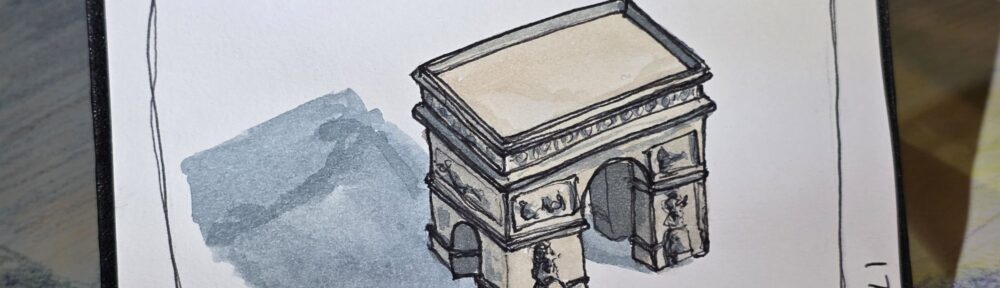
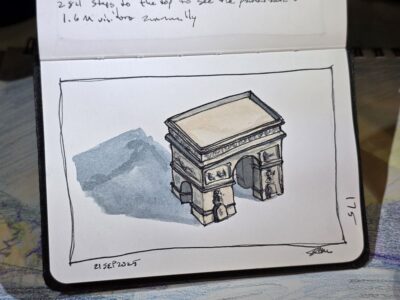
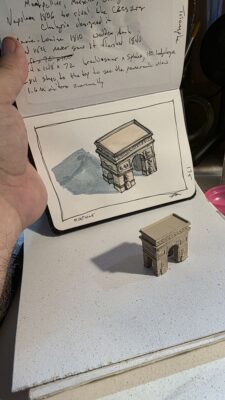
Today’s random object was the Arc de Triomphe. A little toy version sat on my desk while I sketched it in ink and watercolor wash, but behind that model is a monument that towers over Paris, covered in stories carved in stone.
Sketch & Coffee, Live! is streamed daily at 5:30am, Texas Time, at the YouTubes
We talked about how Rome invented triumphal arches as giant billboards of power. They told of victories in bas-relief, with columns and inscriptions meant to outlast the battles themselves. After Rome fell, arches faded away, but the Renaissance brought them roaring back as architects studied the ruins and put arches back on city streets. France followed suit, filling Paris with arches like Porte Saint-Denis and Porte Saint-Martin before Napoleon declared he wanted one to rival the Caesars.

Napoleon commissioned the Arc de Triomphe in 1806 after his victory at Austerlitz. He even had a wooden stand-in built for his wedding procession since the real one wasn’t ready. The stone version dragged on for decades, finished in 1836, long after Napoleon’s death. In 1840 his remains passed through it in a solemn parade. The Arc stands 164 feet tall, about as high as a brachiosaurus, 148 feet long like the Sphinx, and 72 feet wide, or roughly 100 hedgehogs nose to tail. With 284 steps to the top, it rises over Paris, its terrace offering a panorama of the city and avenues spreading out like spokes on a wheel.

As I worked the sketch, the little figurine could only hold the essence of battle, essence of shields, and essence of relief sculptures. The real monument bristles with angels, generals, and battle names cut deep in stone. Even with a quick 30-minute sketch, you feel why this arch became more than just a gate. It’s a storybook carved in stone, still drawing millions to Paris and fueling the city’s heart.
Click here to watch this episode of Sketch & Coffee!
Also, if you, or a teacher friend, would like a 20-30 minute lesson plan about the Arc de Triomphe, feel free to download and share this one:
Leave a Reply