
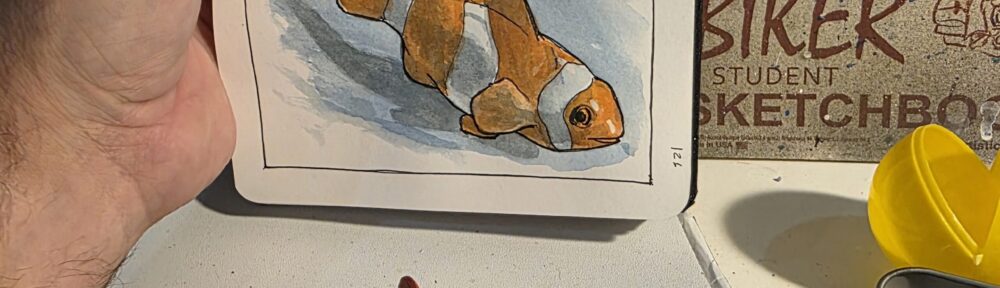

When it comes to clownfish, I can tell you a lot, and not just because I love drawing them. I’ve been fascinated with aquariums for a very, very long time.
Sketch & Coffee, Live! is streamed daily at 5:30am, Texas Time, at the YouTubes
In college, I simplified my life by making all my papers, presentations, and everything else about aquariums. I wrote at least 20 different papers on the subject for classes like physiology, botany, and ecology. My mom typed many of my papers, so she’s almost as knowledgeable about aquariums as I am.
Back in the 70s and 80s, people didn’t really think about traumatizing fish. I remember as a kid, they would give away goldfish and other tropical fish in little baggies as prizes at the fair. Nobody cared how many died because nobody cared if they were traumatizing the fish.

Clownfish themselves are a huge success story in the aquarium trade because they’re easy to keep. They were one of the first sustainable, ethically sourced aquarium animals, mostly bred in captivity. This is a big deal, because most other popular aquarium fish, like blue tangs and seahorses, are still caught in the wild. This method is damaging because clownfish live in anemones, and catching them often means destroying the whole reef. So, they started breeding programs for clownfish very early on.

Anemones, on the other hand, are difficult to breed and don’t do so well in captivity. The ones that hobbyists do have are mostly wild caught, but at least the wild populations are ethically maintained through a process called mariculture. Thankfully, clownfish don’t actually need an anemone to survive in a tank, as long as they have a place to hide.
And now for the queen drama. Clownfish live in a matriarchal society, led by a large female, but they are all born male. The largest and most dominant one will change sexes to become female. The next largest male becomes the dominant breeding male, and the rest of the males become sterile. If something happens to the female, the breeding male will change sexes, and the next largest male will step up and become non-sterile. To avoid being poisoned by their venomous anemone, they coat their bodies with a layer of mucus. It’s some wild queen drama for sure.
Click here to watch the clownfish episode oof Sketch & Coffee, Live!
Also, for my teacher friends, I’ve prepared a 20-30 minute lesson plan available for download. Drop me a line if you find it useful.
Leave a Reply