

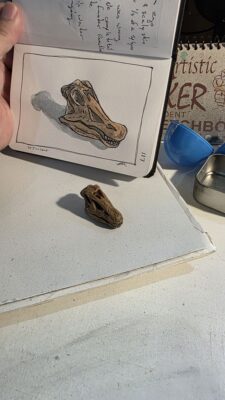
This morning’s random object was a Diplodocus skull. Diplodocus were the long, slender, and maybe graceful sauropods of Minnesota.
Sketch & Coffee, Live! is streamed daily at 5:30am, Texas Time, at the YouTubes
Now, whether it’s “di-PLOD-oh-kus” or “dip-LOD-uh-kus,” both are apparently acceptable, though one is preferred in Britain and the other in the United States. I’ve always said “di-PLOD-oh-kus” since the 80s, so I’m sticking with it. Even Jurassic Park called it DiploDOEcus.
Diplodocus roamed the North American plains, specifically around Minnesota, about 147 to 150 million years ago. Dating something that old isn’t an exact science; you can’t exactly count rings or ask their birthday. But by looking at rock layers and carbon dating signatures, scientists can get it within about 10 million years. Ten million years is a lot, but hey, it’s pretty old!
Diplodocus belongs to a group called sauropods, which means “lizard foot” and refers to the long-necked dinosaurs. Of all the sauropods, Diplodocus was one of the longest, if not the longest, especially for its size. These guys were about 85 feet long. To put that in perspective for my Non-American friends, that’s roughly 121 bananas or a third of a sphinx. Bananas!
They had small peg teeth only in the front of their mouths, which they used for stripping underbrush. They didn’t chew their food. Scientists believe they didn’t raise their heads like giraffes but instead swept their heads from side to side in about a 200-degree arc to eat. This conserved energy since moving a 12-ton body every time you wanted a bite would be exhausting. My personal conjecture is that they lived on the edge of marshes, using their long, inflexible necks to reach food off the shore. It just doesn’t make evolutionary sense to me for them to sweep around on dry land.
It’s important to remember that there are no complete Diplodocus skeletons. Early museum reconstructions, like the one Andrew Carnegie oversaw, were based on incomplete skeletons and conjecture. They even used forms from other dinosaurs like Apatosaurus and Brachiosaurus to fill in the gaps. For example, the very tip of their tails was imagined. For all we know, they had lasers on the ends of their tails.
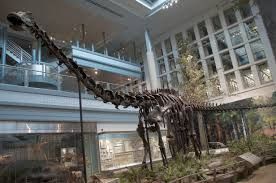
Initially, museums also incorrectly displayed them in a “lizard sprawl” with legs splayed out, and their necks held high like a swan. This would have meant their breastplate dragged on the ground, and there’s no evidence of that. They eventually corrected this, positioning the legs underneath the body. But it makes you wonder how much “absolute fact” there is in science if they can make such big mistakes and not readily admit to them. Science is not settled.
They also had a hip nerve bundle, which was once thought to be a “second brain” to help them react quickly if their long tail was stepped on. While not a brain, this nerve bundle likely allowed for faster reactions to stimulus. I tease my 6’4″ sons about needing this.
What truly fascinates me is that Diplodocus remains are found only in North America. During the time they lived, the continents were still connected, and other animals moved between them. The fact that Diplodocus didn’t cross over suggests to me they were specialized for marshy environments and couldn’t stray too far from their food source. They were successful for several million years, and there were millions of them, so they were a successful animal.
Click here to watch the Diplodocus episode of Sketch & Coffee, Live
Leave a Reply