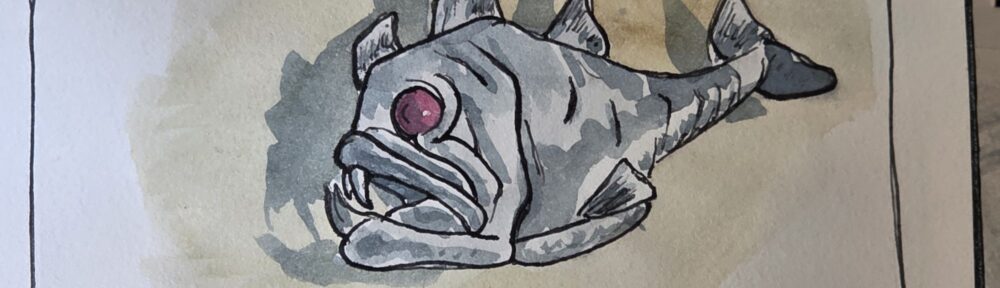

This morning at Sketch and Coffee Live at 5:30am Texas time, I pulled a toy labeled as a hatchetfish. The problem was, once I dug into it, nothing about it matched the photos of actual hatchetfish.
Sketch & Coffee, Live! is streamed daily at 5:30am, Texas Time, at the YouTubes
The teeth and eyes were wrong. It looked much more like a mix of a hatchet fish and a dragonfish, and sure enough, the deeper I looked the more the pieces fit. Hatchetfish are tiny, only about the size of a paperclip, while dragonfish reach about the length of a human hand. Both families share bioluminescence, but the details are different.

Hatchetfish use photophores on their bellies to erase their shadows. They hover in the twilight zone, watching for silhouettes to cross above them, then dart up to feed. Dragonfish, on the other hand, generate their own spectrum of light. They broadcast beams that other fish cannot see, and their eyes are tuned to detect those hidden wavelengths. It is like carrying built-in flashlights that only they can use. This makes them hunters of the midnight zone, where no sunlight ever filters down.

These fish diverged from shallow-water ancestors about 100 million years ago, then split further into dragonfish, hatchetfish, anglerfish, and others around 60 million years ago. There is no fossil record for their soft bodies, so scientists use mitochondrial DNA to trace their history. Today they live in the mesopelagic and bathypelagic zones, anywhere from 200 to 2000 meters deep. To early sailors or divers, a glimpse of one of these nightmare faces would have been terrifying. Yet despite their small size, their adaptations are shaping modern science.

By studying how they create and detect light, engineers are building cameras sensitive enough to see in near total darkness. These tools are being tested in self-driving cars, microscopic surgery, and deep-sea exploration. Even space science is borrowing ideas. Lobster-eye optics and deep-sea style imaging now help telescopes record faint signals from the stars. What began as survival tricks in the deep are shaping how we see both our planet and the cosmos.
Click here to watch this episode of Sketch & Coffee!
Also, if you or a teacher friend would like a 20-30 minute lesson plan on Hatchet Fish and Dragonfish, feel free to download and share this one:
Leave a Reply