
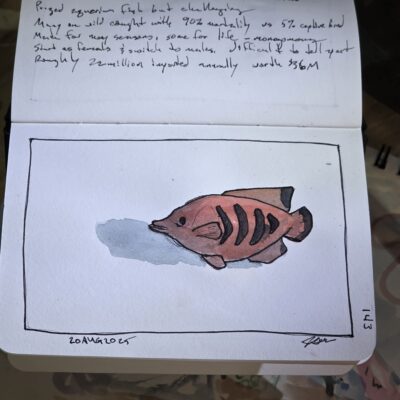
Today’s random object from the Randomogrifier was a flame angelfish figurine.
Sketch & Coffee, Live! is streamed daily at 5:30am, Texas Time, at the YouTubes
Yhe body shape of this flame angelfish is similar to the blue tang I did recently. Marine angelfish are cousins to tangs, which explains their similar body shape. This was a marine angelfish, not the freshwater kind. Freshwater angelfish are cichlids. Marine angelfish belong to the Pomacanthidae family, which means “thorn-covered,” a nod to the spines along their gill covers. That’s the big difference, aquarium angelfish don’t have those spines. Both groups may have sweeping fins, but the cheek spines are what put this one in the angelfish family.

We talked about their evolutionary line, going back about 100 million years. Around 30 million years ago the spined Pomacanthidae showed up, and 75,000 years ago you get today’s flame angelfish. That’s based on mitochondrial DNA, since colors don’t fossilize. There are 80 to 90 recognized species, though scientists argue endlessly about classification. They live on reefs where they graze algae off coral, a mutually beneficial arrangement.
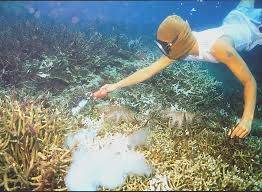
Their bright colors make them popular aquarium fish, but also make them targets for collectors. Unfortunately, many are caught with cyanide, which stuns them and kills the coral, leaving a 90% mortality rate for the fish within a month. Even net-caught angelfish see about a 20% loss. Captive bred angelfish survive much better with only around 5% morality, but they are harder to breed and so most of the market remains wild-caught. Angelfish are monogamous, sometimes mating for life. They are born female and some change into males later, which makes it nearly impossible to sex them without seeing them as a pair. When pairs are split during collection, one fish is left to defend territory and brood alone. That doesn’t end well.
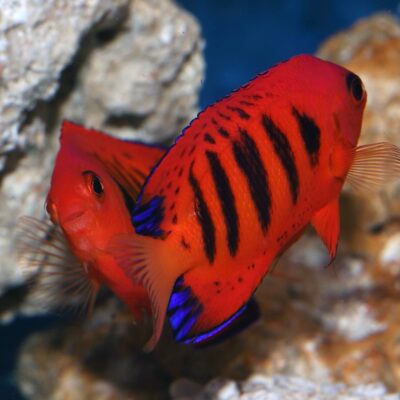
Roughly 22 million ornamental reef fish are imported into the U.S. annually, worth about $36 million. The beauty of these fish is their downfall, both in the wild and in tanks where they are notoriously territorial and need a large tank to survive.
Click here to watch the Angelfish episode of Sketch & Coffee, Live!
Also, if you or a teacher friend of yours is in need of a 20-30 minute lesson about Angelfish, feel free to download and use this lesson plan:
Leave a Reply