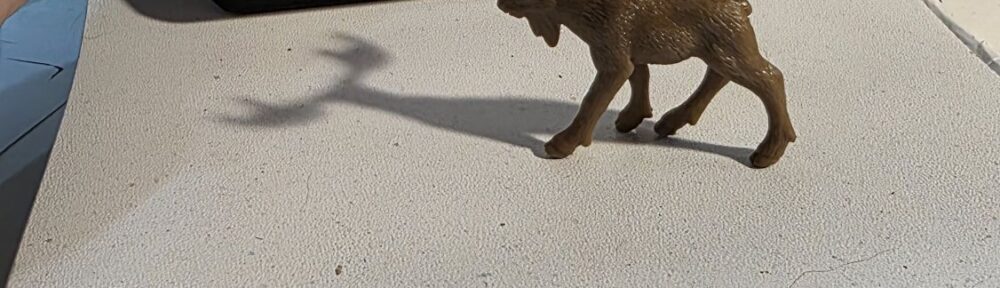
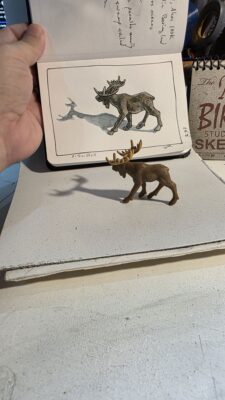
Moose are one of the last holdouts of the Pleistocene megafauna, and I can’t help but admire that.
Most of their giant, shaggy cousins like giant sloths, mammoths, and mastodons, are all extinct. But the moose? Moose are still out here just moosing along, producing a couple of calves a year and stomping anything that looks at them funny.
They’re not endangered. In fact, there are about 2 million moose worldwide, and Sweden alone hands out 80,000 permits a year, harvesting about 70,000. The U.S. has tighter restrictions, with lottery-based hunting and more cow permits than bulls to keep gene pools diverse. But either way, they’re thriving. Why? Because they reproduce fast, they live where no one else wants to, and most things that try to eat them either hibernate half the year or get drop-kicked into the moss. Bears, wolves, ticks, are their natural threats, but moose come prepared. Except for ticks. No one is really prepared for ticks.
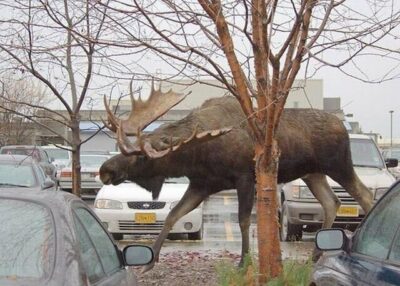
They split off from their closest extinct relative, Cervalces, about 100,000 years ago. Humans are cited as a cause of their demise. But, while there may have still been pockets of Cervalces around 15000 years ago, Humans didn’t wipe Cervalces out. There were barely enough people to fill a football stadium back then. Alces, the modern moose, just outcompeted them. They’re better breeders, more cold-tolerant, and more adaptable.
The moose in Eurasia and North America have been isolated for roughly 15K years. But since they live in taiga forests on both continents with similar climate and predators, they never had any reason to evolve apart. Even after this time, they are still relatively the same species.
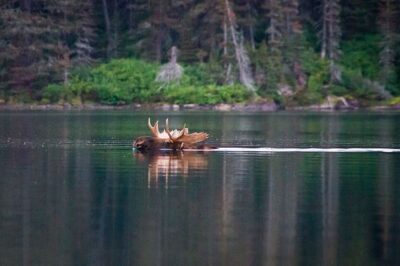
And yes, they’re excellent swimmers. They will dive up to 6M for tasty aquatic plants, and can swim for miles, sometimes from island to island. Which brings us to one of the most bizarre moose facts of all time: orcas have been known to eat moose. Not a joke. While sharks will usually spit out land mammals, orcas just look at a swimming moose and snatch it up. It’s not common, but it’s happened more than once. You can practically hear the sharks clutching their pearls: “Oh my, how crude!”
Click here to watch the Moose episode
Takeaways to talk about…
1. Alces split from Cervalces around 100,000 years ago
The extinct stag-moose (Cervalces scotti) was outcompeted by modern moose in the late Pleistocene.
Source: http://www.fossilworks.org/cgi-bin/bridge.pl?a=taxonInfo&taxon_no=37468
2. Moose crossed into North America via the Bering Land Bridge 10,000–15,000 years ago
Fossil and genetic evidence shows moose migrated from Eurasia during the last glaciation.
Source: https://www.nps.gov/bela/learn/nature/bering-land-bridge.htm
3. No speciation occurred due to shared environments and stable pressures
Genetic studies show North American and Eurasian moose remain one species due to similar habitats and predators.
Source: https://academic.oup.com/jmammal/article/85/3/585/873069
4. Global wild moose population is estimated around 2 million
Moose are not endangered and are listed as “Least Concern.”
Source: https://www.iucnredlist.org/species/41777/22156288
5. Sweden issues ~80,000 moose hunting permits annually
They harvest around 70,000 moose per year as part of structured wildlife management.
Source: https://www.naturvardsverket.se/en/topics/hunting/hunting-of-large-game/moose-hunting/
6. Moose browse on shrubs, twigs, and marsh plants
They eat willows, birch, aquatic vegetation, and young branches—never grass like cattle.
Source: https://www.adfg.alaska.gov/index.cfm?adfg=moose.main
7. Moose are excellent swimmers and cross lakes and inlets
They can dive up to 20 feet and swim long distances, even between saltwater islands.
Source: https://www.smithsonianmag.com/smart-news/moose-can-dive-almost-20-feet-deep-underwater-180970039/
8. Main threats: bears, wolves, and tightly regulated human hunting
Predators mostly take calves. Hunting is controlled with quotas and seasonal limits.
Source: https://www.dnr.state.mn.us/mammals/moose.html
9. Orcas have been recorded eating moose
Rare, but confirmed, killer whales have preyed on moose swimming off the coast of Alaska and British Columbia.
Source: https://www.canadianfieldnaturalist.ca/index.php/cfn/article/view/449
Below is a lesson plan, talking points, rubric, and worksheet:
Leave a Reply