Seahorses are armored, awkward, floaty little ghosts that barely swim and somehow still survive.
Sketching and Coffee, Live! is streamed daily at 5:30am, Texas Time, over at the YouTubes
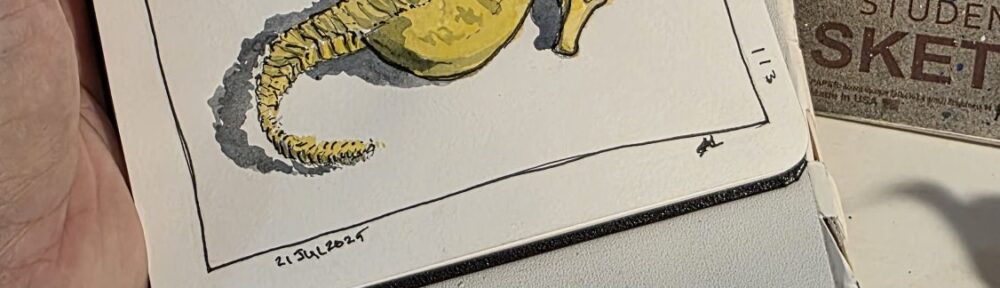
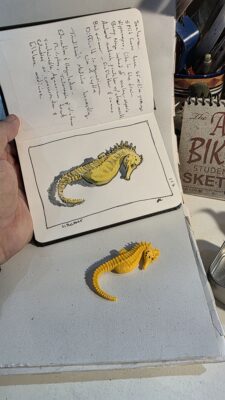
This morning’s random object from the Random Object Randomogrifier was a seahorse. I spritzed the watercolors to get them juicy, turned the sketchbook the right way, and tried to draw it without every single little knob. Just enough to show they’re there. It’s hard to believe these things are even alive. They just look so mysterious. This toy is spiny, upright, kind of stiff, and that’s actually about right.
Seahorses are related to tuna and mackerel. About 65 million years ago, the ancestor of both split. One went open ocean and got fast. The other went into the marshes and gave up all useful motility. Seahorses started showing up around 20 million years ago. They’re basically modified pipefish, long, skinny fish with bony plates. Instead of ribs or scales, they’ve got these ringlets of fused bony armor with skin stretched over the top. Seahorses help keep marshes and reefs clean by eating excess plankton. That lets sunlight reach the bottom so everything else can grow.
They can’t swim well. They’ve got one little fin on the back that undulates to push them, and a tiny fin on each side for steering. That’s it. They’re slow and awkward. They anchor to seagrass with their little prehensile tails and just wait for food to float by. Zooplankton swims past, they suck it in with a long tube snout. No jaws.
The most famous thing about seahorses is that the males carry the babies. The female puts eggs into the male’s pouch, and he fertilizes and hatches them.
I bet if they were better swimmers, you wouldn’t see nearly as much of that.
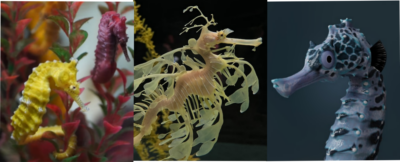
Their scientific name is Hippocampus, which is also the name of a part of the brain. That’s not a coincidence. Anatomists saw the curlicue shape in the brain and thought it looked like a seahorse.
In real life, their biggest threat is us. We collect them for aquariums where they don’t compete well with the other animals and starve. We grind them for traditional medicine, for everything from digestion issues to virility, with no proven effect. And we dry them for decorations and souvenirs. I feel it important to point out that if you’re the kind of person that is grinding up small animals and ingesting them to make you more attractive to the opposite sex, you’re doing it wrong. This is not good for the seahorse population, and it is not making you more attractive to the ladies.
But there’s progress. In the Philippines, Vietnam, and Indonesia, communities are learning to farm and harvest seahorses sustainably. Younger generations are looking for more evidence based medicinal practices. And aquarists now have better breeding programs and classes. People are even 3D printing souvenirs instead of drying real ones. Maybe one day we can get the traditional medicine poachers to snort those too.
Click here to watch the Seahorse live stream over at the YouTubes
Leave a Reply